
What Makes FUE Hair Transplant Different From Older Hair Restoration Methods?
If you have started researching hair restoration in San Diego, California, chances are you have already come across a handful of confusing terms: strip surgery, FUT, grafts, donor sites, and of course, FUE. Maybe you noticed a receding hairline that seems to shift a little more each year, or a thinning crown that is harder to hide with a different part. Maybe a friend or family member had a transplant years ago and you still remember the linear scar at the back of their head. That memory alone is often what brings people to ask a very specific question: is there a hair transplant option that does not leave that kind of mark?
That is where FUE hair transplant comes in. At California Hair and Skin Institute, we perform FUE using the NeoGraft system, a modern approach designed to restore natural looking hair density without the linear scarring associated with older surgical techniques. This article walks through what actually causes the hair loss patterns that lead people to consider a transplant, how FUE compares to older methods, what the process looks like from start to finish, and what recovery and results realistically involve.
What Hair Loss Patterns Make Someone Consider a Transplant in the First Place?
Not everyone experiencing hair loss needs, or is even a candidate for, a transplant. The patterns that usually bring people through our doors involve a receding hairline, a thinning crown, or overall diffuse thinning that has stabilized into a recognizable shape rather than continuing to shift unpredictably.
Most of this comes down to androgenetic alopecia, more commonly known as male or female pattern hair loss. It is a genetic and hormonal process where hair follicles in certain areas of the scalp gradually become more sensitive to dihydrotestosterone (DHT), a byproduct of testosterone. Over time, affected follicles produce thinner, shorter hairs until they eventually stop producing hair altogether. What makes this pattern significant for transplant candidacy is that it is predictable. Follicles at the back and sides of the scalp, known as the donor area, are typically resistant to DHT and remain healthy for life. That is the entire foundation of hair transplantation: moving resistant, healthy follicles to areas where they have thinned or disappeared.
Other patterns worth understanding include traction alopecia from tight hairstyles, thinning related to stress or hormonal shifts, and patchy loss in the beard or eyebrows. You can read more about the specific patterns we address on our receding hairline and balding concerns page, which breaks down what stable versus progressive hair loss can look like.
What Is FUE and How Is It Different From Older Hair Transplant Methods?
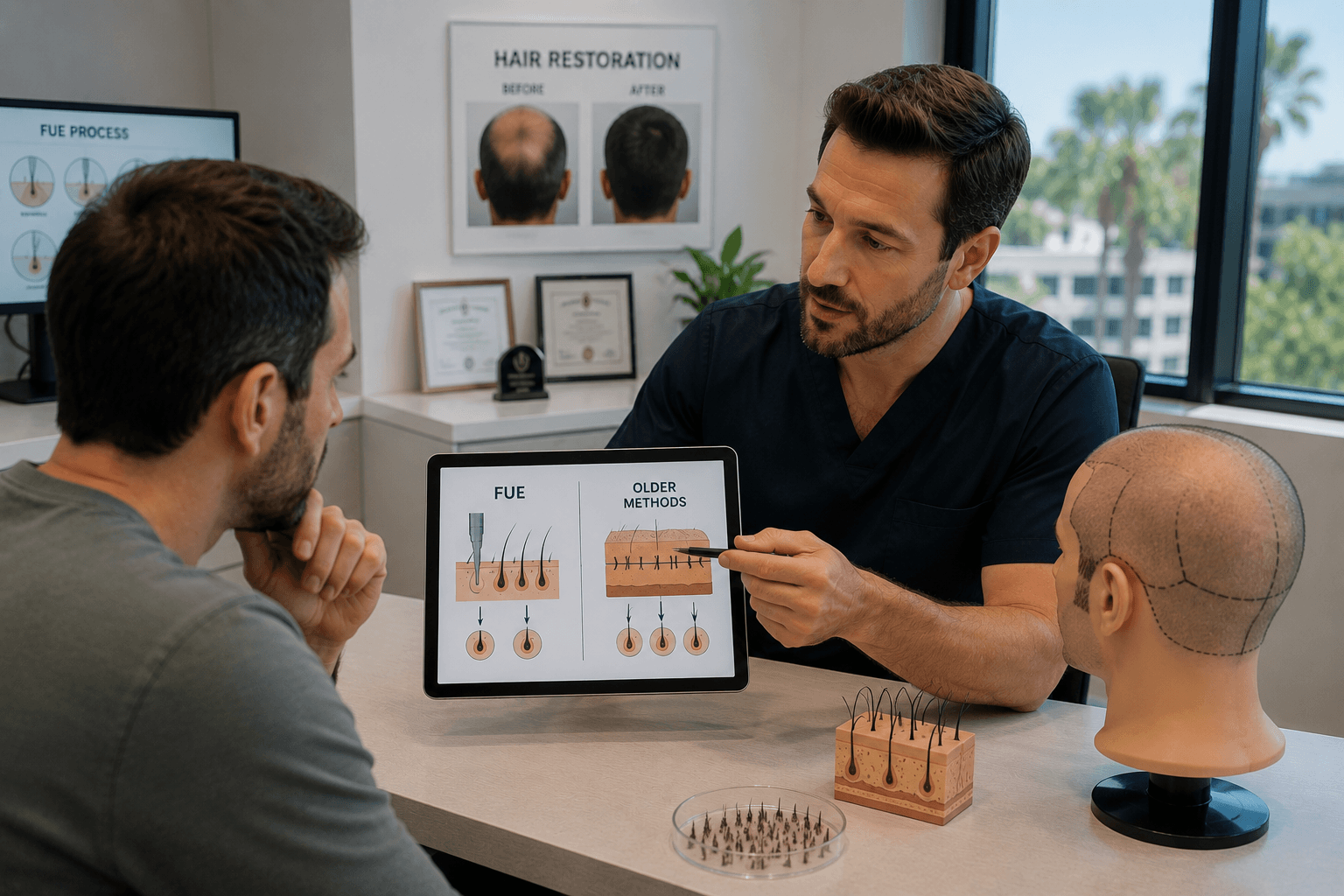
FUE stands for follicular unit extraction. Instead of removing a strip of scalp tissue (the older FUT, or follicular unit transplantation, method), FUE involves extracting individual hair follicles one at a time directly from the donor area, then implanting them into the thinning or balding sections.
The older strip method required cutting out a linear section of scalp, then closing the wound with sutures or staples. This left a permanent linear scar across the back of the head, which limited hairstyle choices for many patients, especially those who prefer to wear their hair very short. FUE avoids that entirely. Because individual follicular units are removed with tiny, precise extractions rather than a single incision, the donor area heals as a scattering of small dots rather than one continuous line. For many patients, that difference alone is the deciding factor.
Why Do More Patients Prefer FUE Today?
Beyond the scarring difference, FUE tends to involve a shorter recovery window, less post-procedure discomfort, and more flexibility in how the donor area is harvested, since follicles can be taken from a broader area rather than concentrated in one strip. It also allows for more precise placement, which matters when the goal is a natural looking hairline rather than an obviously "pluggy" result reminiscent of older transplant techniques from decades past.
At our practice, we perform FUE hair transplant procedures using the NeoGraft system, an automated extraction device that helps standardize graft harvesting and reduce trauma to individual follicles during removal. You can see the technique in more detail on our FUE hair transplant using NeoGraft service page.
How Does FUE Compare to Non-Surgical Options Like PRP?
It is worth noting that not every case of thinning hair calls for surgery. Treatments like PRP (platelet-rich plasma) can help stimulate existing follicles that are miniaturizing but not yet dormant, and are often used as a standalone treatment for early thinning or as a complement to a transplant to support graft health during healing. FUE, on the other hand, is the appropriate option when follicles in a given area have already stopped producing hair and there is nothing left to stimulate. During a consultation, we assess where you fall on that spectrum before recommending a path forward. You can browse the range of options under our hair restoration services category.
What Does the FUE Process Actually Look Like, From Consultation to Procedure?
The process begins with a thorough hair restoration consultation, where we evaluate your scalp, donor supply, hair characteristics, and the pattern and stability of your hair loss. This is also when we discuss realistic expectations and design a hairline that suits your face shape and age.
On the day of the procedure, the donor area is trimmed and numbed with local anesthesia. Using the NeoGraft device, individual follicular units are extracted one at a time from the donor zone, typically the back and sides of the scalp. Once enough grafts are collected, tiny recipient sites are created in the thinning areas, and the grafts are carefully placed following the natural direction and angle of existing hair growth. Depending on the number of grafts needed, sessions can take several hours, and most patients are comfortable enough to relax, listen to music, or watch something during the process.
Can FUE Be Used for More Than Just the Scalp, Like Beard or Eyebrows?
Yes, and this is one of the reasons FUE has become so versatile. The same extraction and implantation principles apply to beard restoration for patients with patchy or thin facial hair, as well as eyebrow restoration for those dealing with thinning or sparse brows from over-plucking, aging, or medical causes. The extraction process is essentially the same, though graft placement requires meticulous attention to angle and direction since facial hair grows differently than scalp hair.
Who Is a Good Candidate for FUE?
Good candidates generally have a stable pattern of hair loss, meaning the areas of thinning have settled rather than continuing to spread rapidly, along with a healthy donor area that can supply enough grafts for the desired result. Age, overall scalp health, and realistic expectations all factor into candidacy as well. Since donor supply is finite, someone in the early stages of progressive hair loss may benefit more from a combination approach that includes non-surgical support before considering surgery. This is exactly why the consultation step matters so much. It is not a one-size-fits-all procedure, and an honest evaluation upfront prevents disappointment later.
What Does Recovery and Downtime Look Like After FUE?
One of the biggest advantages of FUE over older strip methods is a noticeably easier recovery. Most patients experience mild redness and small scabbing at both the donor and recipient sites for the first several days, along with some tightness or tenderness. Because there is no linear incision to heal, there are no sutures to remove and discomfort tends to be minimal compared to FUT.
We provide detailed aftercare guidance following every procedure, and you can review our general approach on the post-operative care protocol page. Most patients return to normal daily activities within a few days, though strenuous exercise and direct sun exposure are typically limited for a short period afterward.
How Soon Will You See Results?
This is often the hardest part for patients to hear, but it is important to set realistic expectations. Transplanted hair typically sheds within the first few weeks, which is completely normal and expected. The follicles then enter a dormant phase before new growth begins, usually starting around three to four months post-procedure. Full results, including thickness and texture, generally take nine to twelve months to fully mature. You can see real patient timelines and outcomes on our before and after page, which reflects the kind of gradual, natural looking progression typical of FUE.
This information has been updated for August 2026 to reflect our current approach to FUE hair transplant procedures at our San Diego location.
Frequently Asked Questions
Is FUE hair transplant painful? The procedure itself is performed under local anesthesia, so most patients feel pressure rather than pain. Mild soreness in the days following the procedure is common but manageable.
How long does an FUE hair transplant take? Depending on the number of grafts needed, a session can take anywhere from four to eight hours, sometimes split across more than one day for larger cases.
Does FUE leave visible scarring? FUE leaves tiny, scattered dot-like marks in the donor area rather than a single linear scar, which typically become very difficult to notice once healed, even with short haircuts.
Can women get FUE hair transplants? Yes, FUE can be appropriate for women experiencing pattern hair loss, thinning at the part line, or thinning eyebrows, depending on the pattern and stability of the hair loss involved.
How do I know if I am a candidate for FUE? The only way to know for certain is through an in-person evaluation of your donor supply, hair loss pattern, and scalp health, which we walk through during a consultation.
The Bottom Line on Getting Your Hairline Back
Deciding to address hair loss is rarely about vanity. It is about feeling like yourself again when you look in the mirror. If a receding hairline, thinning crown, or patchy beard has been on your mind, an honest conversation about whether FUE is the right fit can save you a lot of guesswork. Our team at California Hair and Skin Institute is here to walk through your options, answer the questions you have not thought to ask yet, and help you figure out the path that actually makes sense for your hair, your goals, and your timeline. You can find more answers to common questions on our FAQ page or reach out directly through our contact page to schedule a consultation.