
How Does an FUE Hair Transplant Compare to Strip Surgery for San Diego Patients?
An FUE hair transplant removes individual follicular units one at a time, while strip surgery removes a narrow band of scalp and divides it into grafts. Both methods move your own hair from a dense donor area to a thinning one. The main differences are how the donor area heals, how short you can comfortably wear your hair afterward, and how quickly most people return to routine activities.
California Hair and Skin Institute in San Diego performs FUE hair transplant using NeoGraft, an automated approach to follicular unit extraction. Below, we compare the two techniques, walk through a typical procedure day, and explain who tends to benefit most from FUE.
What Is Follicular Unit Extraction?
Follicular unit extraction, often shortened to FUE, harvests naturally occurring groups of one to four hairs directly from the scalp, usually from the back of the head. The International Society of Hair Restoration Surgery (ISHRS) describes these groups as follicular units and notes they are extracted with very small punches, typically between 0.7 and 1.2 millimeters.
NeoGraft adds pneumatic pressure to the process, gently helping lift each follicle from the scalp. The grafts are then placed into tiny recipient sites in the thinning area, following your natural growth direction.
FUE vs. FUT: What Are the Key Differences?
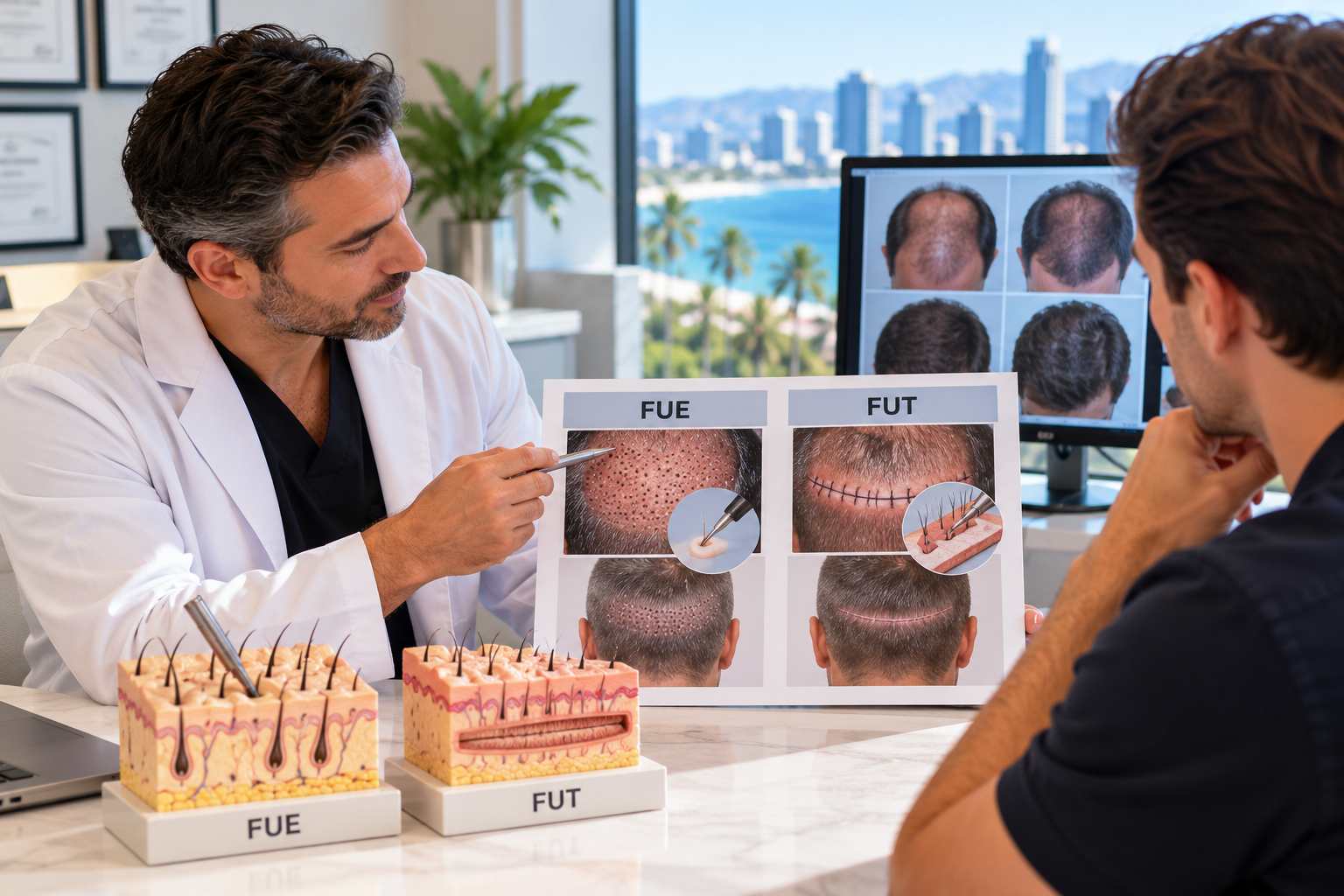
Follicular Unit Extraction (FUE) and Follicular Unit Transplantation (FUT) are two established hair transplant techniques. Both involve transferring healthy hair follicles from a donor area to areas experiencing hair loss, but they differ in how the follicles are collected, the resulting scars, and the recovery process.
Here are the key differences to consider:
- Harvesting Method: FUE removes individual follicular units directly from the donor area, while FUT removes a strip of scalp that is divided into individual grafts under magnification.
- Stitches and Healing: FUE typically requires no stitches in the donor area, whereas FUT involves closing the strip incision with stitches or staples.
- Scarring: FUE leaves small, scattered scars, while FUT creates a linear scar along the donor area. Both techniques produce permanent scarring.
- Hairstyle Flexibility: FUE may be preferable for patients who wear shorter hairstyles because its small scars can be less noticeable. FUT scars may become visible with very short haircuts.
- Donor Area Preparation: FUE often requires shaving part or all of the donor area, although some techniques allow limited shaving. FUT generally requires trimming the strip being removed.
- Alternative Donor Hair: FUE can sometimes use beard or body hair when appropriate, while FUT typically relies on scalp donor hair.
Neither technique is automatically better for everyone. The right choice depends on your hair loss pattern, donor hair availability, scalp condition, preferred hairstyle, and restoration goals. A consultation with a qualified hair transplant specialist can help determine which approach best suits your needs.
Is FUE Completely Scarless?
No hair transplant is completely scarless. ISHRS states plainly that FUE is not scarless, because every extraction creates a small wound. The difference is that FUE marks are tiny and spread out, so they are typically hard to notice once surrounding hair grows in. Strip surgery leaves a single line that may become visible with very short haircuts.
Is FUE Always the Better Choice?
Not always. ISHRS notes that FUT generally requires less surgeon labor and is often less expensive, and patients who always wear longer hair may be less concerned about a linear scar. At California Hair and Skin Institute, the practice focuses on FUE with NeoGraft, so your consultation will center on whether FUE is appropriate for your hair loss pattern and goals.
What Happens on the Day of an FUE Hair Transplant?
An FUE procedure is an in-office treatment performed under local anesthesia. At California Hair and Skin Institute, most procedures take between four and eight hours, depending on graft count.
Step 1: Planning and Hairline Design
Dr. Vakas Sial reviews your goals and marks the treatment area. The hairline is designed to suit your facial proportions and age, with irregular, softer edges that look natural.
Step 2: Local Anesthesia and Harvesting
The donor and recipient areas are numbed. Most patients feel pressure rather than pain. Follicles are then harvested one at a time from the donor zone.
Step 3: Graft Placement
Grafts are placed at angles that mirror your existing hair. Single-hair grafts are generally used along the front edge for a soft transition, with denser grafts placed behind them.
Step 4: Aftercare Instructions
You leave with specific guidance for sleeping, washing, and protecting the grafts. Patients typically return within 24 to 48 hours for a post-operative check and a gentle professional hair wash.
How Long Is FUE Recovery Time?
Many patients return to work and normal routines within a few days after an FUE hair transplant, though healing varies. Expect mild redness, small crusts, and some swelling during the first week. The institute's post-transplant care and follow-up guidance includes keeping your head elevated while sleeping, avoiding heavy exercise for at least the first week, protecting your scalp from the sun, and avoiding tight hats as the skin heals.
Transplanted hairs commonly shed in the weeks after surgery. This is expected. New growth typically begins around three to four months, with more noticeable density between nine and twelve months.
What Can Affect the Results of an FUE Hair Transplant?
Several factors shape how full and natural your result looks. Donor density sets the upper limit on how many grafts can be safely harvested. Hair characteristics matter too, since thicker or wavier strands tend to create the appearance of more coverage than very fine, straight hair. How carefully you follow aftercare instructions during the first two weeks helps protect newly placed grafts.
The behavior of your native hair is just as important. A transplant restores coverage in targeted areas, but it does not stop pattern hair loss in the hair around it. Depending on clinical need, your post-operative plan may include medical therapy to help preserve existing hair, and supportive options such as PRP/PRF therapy are sometimes discussed. Dr. Sial will explain which, if any, are appropriate for you.
Who Is a Good Candidate for an FUE Hair Transplant?
Strong candidates have a stable hair loss pattern, healthy donor hair, and realistic expectations. Dr. Sial evaluates these factors during a hair restoration consultation, along with your medical history and any scalp conditions that could affect healing.
Busy Professionals Who Need Minimal Disruption
For professionals in San Diego juggling deadlines, travel, and client meetings, FUE's lack of stitches and its relatively short downtime are often the deciding factors. Many patients schedule their procedure before a weekend or a few days off. A loose-fitting hat can be worn once your provider approves it, and the early crusting phase typically settles within the first one to two weeks. If you have a major presentation or event, plan your procedure date with that window in mind.
Men Who Prefer Short Haircuts
Many men in San Diego favor short fades and close trims, especially in warmer months. Because FUE avoids a linear donor scar, it gives more flexibility with shorter styles. Your donor area will usually be shaved for the procedure, so some men choose to go short beforehand so the change is less noticeable.
Women Considering FUE
Women with thinning concentrated in particular areas, such as a widening part or frontal thinning, may be candidates if their donor hair is healthy. ISHRS points out that women sometimes experience diffuse thinning that also affects the donor zone, so careful evaluation matters. Women who wear longer hair often find that it covers a shaved donor area well during healing, though options for limited shaving should be discussed during consultation.
Can FUE Be Used Beyond the Scalp?
Yes. The same follicle-by-follicle approach is used for beard restoration and eyebrow restoration at California Hair and Skin Institute. These procedures require careful angle and direction planning because facial hair grows flatter and in different patterns than scalp hair.
Frequently Asked Questions
Is an FUE hair transplant painful?
FUE is performed under local anesthesia, so most patients feel pressure and minimal discomfort during the procedure. Mild tenderness, tightness, or swelling can occur for a few days afterward.
Will people notice I had an FUE hair transplant?
During the first week or two, redness and small crusts may be visible up close. After that, most changes are subtle until new hair starts growing several months later.
How many FUE sessions will I need?
Many patients reach their goals in one session. People with extensive hair loss, or whose native hair continues to thin, may choose a second procedure later.
Do I have to shave my head for FUE?
The donor area is usually shaved so follicles can be extracted precisely. Whether the recipient area needs trimming depends on your treatment plan, which Dr. Sial will review with you.
Is FUE better than FUT for every patient?
No. Each technique has trade-offs. FUE avoids a linear scar and typically allows quicker recovery, while FUT is still used by some surgeons for certain high-graft cases. Your diagnosis, donor supply, and hairstyle preferences guide the best approach.
One Follicle at a Time, One Confident Look at a Time
FUE gives many patients a way to restore thinning areas without a linear scar or stitches, but the technique works best when it is matched to the right diagnosis and a well-preserved donor area. If you want to know how NeoGraft FUE could fit your hair, schedule, and goals, contact California Hair and Skin Institute to arrange a consultation with Dr. Vakas Sial in San Diego.