
Hair Replacement Options Explained: What Actually Fits Your Situation
"Hair replacement" gets used as an umbrella term for a lot of very different approaches, from wigs and toppers to surgical procedures that permanently restore your own growing hair. If you're trying to figure out which category actually applies to your situation, it helps to understand what each option really involves, who it works best for, and what long-term results actually look like.
What Does Hair Replacement Actually Mean?
Broadly, hair replacement refers to any method used to restore the appearance of fuller hair in areas affected by thinning or baldness. This can range from temporary, non-surgical solutions like hairpieces and topical fibers to permanent, surgical solutions like a follicular unit extraction transplant that relocates your own living hair follicles to thinning areas. Understanding the difference between temporary coverage and permanent regrowth is the most important distinction to make early on.
What Causes the Hair Loss That Leads People to Consider Replacement?
Most people exploring hair replacement are dealing with androgenetic alopecia, the genetic pattern of hair loss driven by DHT sensitivity in certain follicles. Others are addressing thinning from traction alopecia caused by tight hairstyles, hair loss following stress or illness, or thinning in specific areas like the eyebrows or beard due to genetics, alopecia, or scarring. The right replacement option really depends on which of these applies, along with how advanced the thinning has become.
Non-Surgical vs. Surgical Hair Replacement: What's the Difference?
Non-Surgical Options
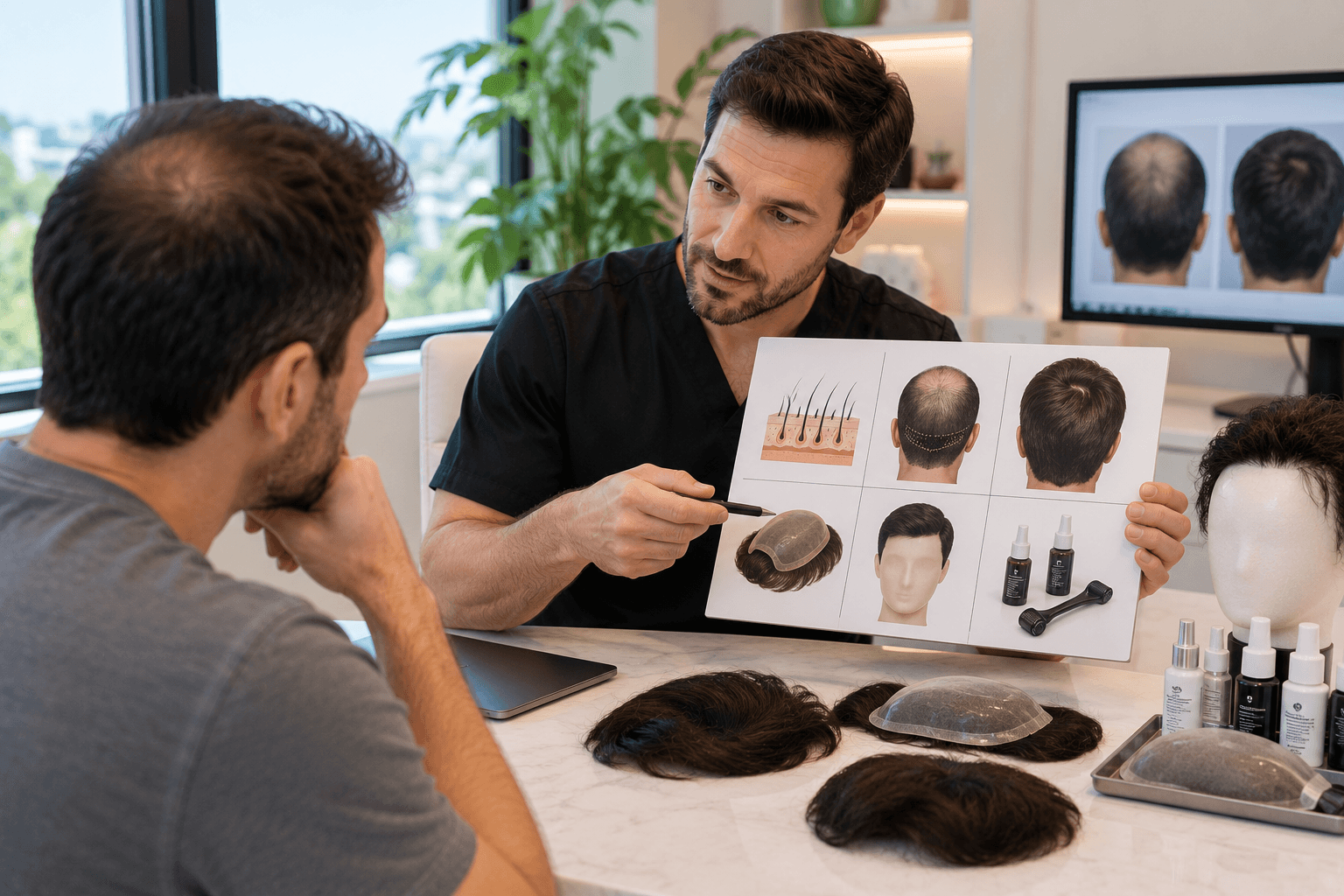
Non-surgical hair replacement includes things like hair systems, toppers, and wigs, which sit on top of the scalp to create the appearance of fuller hair without altering the biology of the follicle underneath. These can be a reasonable short-term option for people not ready for a procedure, but they require ongoing maintenance and don't address the underlying cause of hair loss.
Surgical Hair Replacement
Surgical hair replacement, most commonly an FUE hair transplant, physically relocates healthy, growing follicles from a donor area to the thinning or balding area. Because the transplanted follicles are typically taken from areas genetically resistant to DHT, they continue growing normally once moved, which is why this option is considered a permanent solution rather than ongoing coverage. You can read more about our approach on the FUE hair transplant page.
Is Hair Replacement Just for the Scalp?
Not at all. Hair replacement techniques are also used for eyebrow and beard restoration, particularly for people dealing with sparse or patchy brows and beards due to genetics, over-tweezing, scarring, or alopecia. At California Hair and Skin Institute, we offer eyebrow restoration and beard restoration using the same precise follicular transplant approach used on the scalp, along with a dedicated option for female eyebrow transplants. You can learn more on our eyebrow restoration page, our beard restoration page, and our female eyebrow transplant page.
What Role Does PRP Play in Hair Replacement?
PRP and PRF therapy aren't a replacement in the surgical sense, but they play an important supporting role. For patients with early to moderate thinning, PRP can stimulate existing follicles and improve density without surgery. For transplant patients, it's often used to support graft health and maintain the surrounding native hair over time. You can read more on our PRP and PRF page.
Who Is a Good Candidate for Surgical Hair Replacement?
Good candidates for an FUE transplant typically have a stable, sufficient donor area, realistic expectations about the growth timeline, and hair loss that has progressed to a point where non-surgical options wouldn't achieve the density they're looking for. Candidates for eyebrow or beard restoration are typically dealing with patchy or thin areas that haven't responded to other treatments. A consultation is the best way to determine which category you fall into.
How Do You Decide Between Options?
A few honest questions can help point you in the right direction. Are you looking for a permanent solution or something more immediate and temporary? Has your hair loss stabilized, or is it actively progressing? Do you have enough donor hair density to support a transplant? Are you comfortable with a several-month timeline for full results, since surgical hair replacement takes time to mature? Walking through these questions with a specialist during a consultation makes the decision much clearer than researching alone.
What Does the Hair Replacement Consultation Process Look Like?
During a consultation at our San Diego practice, we evaluate your scalp, brows, or beard area depending on your concern, review your medical history and hair loss pattern, and discuss realistic options based on your donor supply and goals. This is also when we talk through cost, timeline, and whether a combination approach, such as a transplant paired with PRP maintenance, makes sense for you. You can schedule your visit through our hair restoration consultations page.
What Should You Expect in Terms of Recovery?
Recovery from an FUE hair transplant is generally straightforward. Most patients return to normal daily activities within a few days, with small scabs at the graft sites resolving within about a week to ten days. Strenuous exercise and direct sun exposure are typically restricted for a couple of weeks. You can find more detail about aftercare on our post-transplant care and follow-up page.
Why Location Matters When Choosing a Hair Replacement Provider
If you're searching for hair replacement options in San Diego, California, working with a provider who specializes specifically in hair and scalp restoration, rather than a general aesthetic practice that offers it as a side service, generally means more precise graft placement, more experience with natural hairline design, and a more personalized treatment plan overall.
Frequently Asked Questions
What's the difference between a hair transplant and other hair replacement methods? A hair transplant permanently relocates your own living follicles, so the transplanted hair grows naturally for life. Non-surgical hair replacement methods sit on top of the scalp and require ongoing maintenance without addressing the underlying follicle.
Can hair replacement be used for eyebrows and beards, not just the scalp? Yes. Eyebrow and beard restoration use a similar follicular transplant technique to address sparse or patchy areas, and can also be a good option for women experiencing thinning brows.
How long do surgical hair replacement results last? Because transplanted follicles are typically resistant to the hormone that causes pattern hair loss, results are considered permanent, though maintaining surrounding native hair may still require ongoing care like PRP.
Is there a non-invasive option before considering a transplant? PRP therapy is a minimally invasive option that can improve density in follicles that are thinning but still active, and it's often a good starting point for earlier-stage hair loss.
How do I know if I have enough donor hair for a transplant? This is evaluated during a consultation, where your donor area is assessed for density and quality to determine how many grafts can be safely and effectively used.
Choosing the Version of Your Hair You Actually Want to Keep
Hair replacement isn't a one-size-fits-all category, and the right choice really comes down to your specific pattern of thinning, your timeline, and whether you're looking for temporary coverage or a permanent solution. If you're in San Diego and ready to explore what fits your situation, we're happy to walk you through every option on the table.