
How Do You Know If You Need a Hair Transplant Near You in San Diego?
You noticed it before anyone else did. Maybe it was a photo from a friend's birthday party where the overhead lighting revealed more scalp than you remembered, or the few extra minutes it now takes to style your hair around a part that seems to be spreading by the week. Once you start noticing hair loss, it is hard to stop noticing it, and it usually does not take long before the search bar becomes the next stop. If you have typed some version of "hair transplant near me" into your phone while sitting in traffic on the 5 or waiting for coffee in North Park, you are not alone, and you are also not jumping the gun. This is exactly the point where most people start figuring out what is actually happening to their hair, and what can be done about it close to home.
This article walks through the early signs that typically send San Diego residents searching locally for help, why an in-person evaluation tends to matter more than any amount of online research, what a real consultation and procedure look like, and how to tell whether a nearby provider is the right one for you.
What Are the Early Signs You Might Need a Hair Transplant?
Hair loss rarely arrives all at once. For most men, it starts subtly at the temples or the crown, a slight recession that makes the hairline look higher or less defined than it used to. For women, it often shows up differently, as a widening part or an overall thinning that makes the scalp more visible under bright light or in ponytail photos. Some people notice their eyebrows thinning too, which can be just as frustrating and just as noticeable in day-to-day life.
The common thread is usually self-consciousness. You start angling your head differently in photos. You avoid certain haircuts. You catch yourself checking the mirror under harsh bathroom lighting more than you used to. These are the moments that usually prompt someone to stop wondering and start searching for real answers, which is a completely reasonable response. Hair loss can stem from genetics, hormonal shifts, stress, or a combination of factors, and understanding the cause is a big part of figuring out what to do next. You can read more about the specific patterns and causes on our page about balding and receding hairlines.
Why Does an In-Person Evaluation Matter More Than Researching Online Alone?
Online research is a great starting point, but it has limits. Every scalp is different, and the same photo of thinning hair can represent very different underlying conditions depending on donor hair density, scalp laxity, the pattern of loss, and how far it has progressed. No article, including this one, can tell you exactly how much donor hair you have available or whether your hairline would look natural with a lower or higher restoration point. That only comes from someone physically examining your scalp.
This is really the value of finding a hair transplant near you rather than trying to make a decision from search results alone. A local, hands-on consultation allows for an accurate assessment of your donor area, your rate of loss, and realistic expectations for density and coverage. It also means you can ask questions in real time, see before and after examples of real patients, and get a sense of whether the practice feels like the right fit before committing to anything.
What Happens During a Hair Transplant Consultation in San Diego?
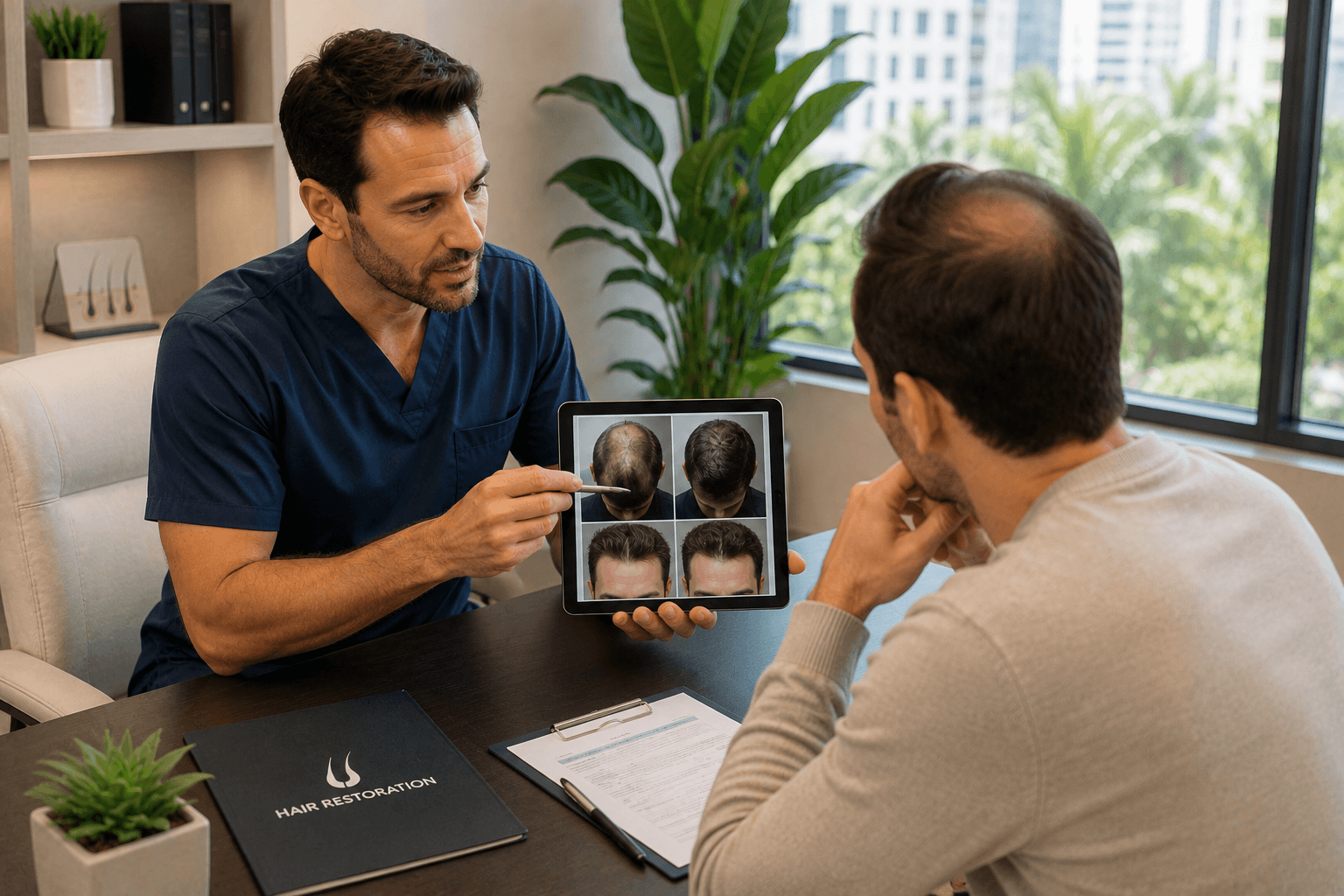
A proper consultation starts with a conversation, not a sales pitch. Expect to talk through your history of hair loss, your family history, any medications or supplements you take, and what you are hoping to achieve. From there, the provider will examine your scalp closely, checking the density and quality of hair in the donor zone, typically at the back and sides of the head, since that is where the grafts will come from.
Photos are usually taken to track progress over time and to help plan the design of your hairline. A good consultation should also cover what your results might realistically look like, how many grafts you might need, and how the procedure would be scheduled around your life. If you are curious about what this process looks like at our practice, our hair restoration consultations page walks through what to expect before you ever set foot in the office.
What Technique Is Typically Used for Hair Transplants Today?
Modern hair restoration has moved well past the plug-like transplants of decades past. Today, follicular unit extraction is the standard approach, and it is performed using a device called NeoGraft, which extracts individual hair follicles from the donor area one at a time and places them precisely where they are needed. Because grafts are removed individually rather than as a strip of scalp, there is no linear scar, recovery tends to be quicker, and the results look far more natural since each follicular unit is placed to follow the direction and pattern of your existing hair growth.
This method works for hairline restoration, crown thinning, and even beard and eyebrow restoration for those dealing with sparse facial or brow hair. You can learn more about how the process works on our FUE hair transplant using NeoGraft page.
Who Is a Good Candidate for a Hair Transplant?
Not everyone who is losing hair is automatically a candidate, and a trustworthy provider should tell you that honestly rather than promising results to everyone who walks in. Good candidates generally have enough healthy donor hair at the back and sides of the scalp to relocate to thinning areas, and their hair loss pattern should be reasonably stable or at least well understood. Age, the extent of loss, and overall scalp health all factor into the equation.
This is another reason an in-person evaluation carries so much weight. Someone with early, well-defined thinning might be an excellent candidate, while someone with more extensive loss and limited donor supply may need a different approach or a combination of treatments. During your visit, your provider should walk you through where you fall on that spectrum honestly, rather than simply telling you what you want to hear.
What Should You Look For in a Local Hair Restoration Provider?
Once you have decided you want a real evaluation, the next step is figuring out which local practice deserves your trust. A few things tend to separate a solid choice from a risky one. Look for a provider who focuses specifically on hair restoration rather than treating it as a side offering, since technique and experience matter enormously in how natural the final results look. Ask to see real before and after photos of previous patients, ideally with hair types and loss patterns similar to your own. Our before and after gallery shows real outcomes from patients across San Diego.
It also helps to see the facility itself, whether in person or through photos, and to understand who will actually be performing your procedure. Transparency about pricing, the number of grafts recommended, and the expected timeline for results are all reasonable things to expect from a consultation. If a practice cannot clearly answer these questions, that alone tells you something.
At our practice, we work with patients from across the region, whether they are coming from downtown, La Jolla, Chula Vista, or further out. You can see the broader areas we serve on our areas we treat page, and browse our full range of hair restoration services to understand what options might apply to your situation.
What Does Recovery and Aftercare Look Like Close to Home?
One underrated benefit of choosing a hair transplant in San Diego rather than traveling elsewhere is how much easier follow-up care becomes. Recovery from FUE typically involves some mild redness and scabbing in the recipient area for the first week or two, with most people returning to normal activities within a few days. Transplanted hairs usually shed within the first month, which is a normal part of the process, before new growth begins appearing several months later and continues to fill in over the following year.
Having a local provider means follow-up appointments, questions about healing, and post-transplant care are all easy to manage without travel or scheduling headaches. It also means if anything feels off during recovery, help is close by rather than a flight away.
This information reflects our current approach to hair restoration as of August 2026, and it is worth noting that consultation availability and techniques are reviewed regularly to keep pace with what works best for patients.
Frequently Asked Questions
How much does a hair transplant near me typically cost? Cost depends on the number of grafts needed, which varies by patient. Pricing is best discussed during a consultation once your specific goals and donor supply have been evaluated.
Is a hair transplant painful? Most patients report mild discomfort rather than significant pain, since the procedure is performed under local anesthesia. Some tightness or tenderness in the days afterward is normal.
How long does it take to see results after a hair transplant in San Diego? Initial shedding of the transplanted hair is expected within the first few weeks, with new growth typically becoming visible around three to four months later and continuing to improve for up to a year.
Can women get hair transplants too? Yes. Female pattern thinning can often be addressed with the same FUE approach, and we also offer treatments specifically designed for female eyebrow and hairline restoration.
Do I need a hair transplant, or would PRP be enough? It depends on the extent of your hair loss and your goals. Some patients benefit from PRP alone, others need a transplant, and some benefit from combining both. A consultation is the best way to determine the right path for you.
So, Ready to Stop Googling and Start Growing?
At some point, scrolling through forums and before and after photos online only gets you so far. The real answers, the ones specific to your scalp, your hairline, and your goals, come from sitting down with someone who can actually examine what is going on. If the search that brought you here started with frustration in front of a mirror, consider this your sign to turn that frustration into a plan. Reach out through our contact us page, take a look at our facility, and find out what a hair transplant near you could actually look like once it stops being a search result and starts being a conversation.