
Stem Cell Hair Treatment: What It Is, What the Research Shows, and What's Available Today
Updated August 2026.
If you've spent any time researching hair restoration, you've probably come across the term stem cell hair treatment. It shows up in medical journals, wellness blogs, and plenty of ads promising to "regrow" hair through cutting-edge science. It's a fascinating area of research, but it's also one of the most misunderstood topics in hair restoration, so let's separate what's real, what's still experimental, and what's actually available to patients in San Diego right now.
What Is Stem Cell Hair Treatment?
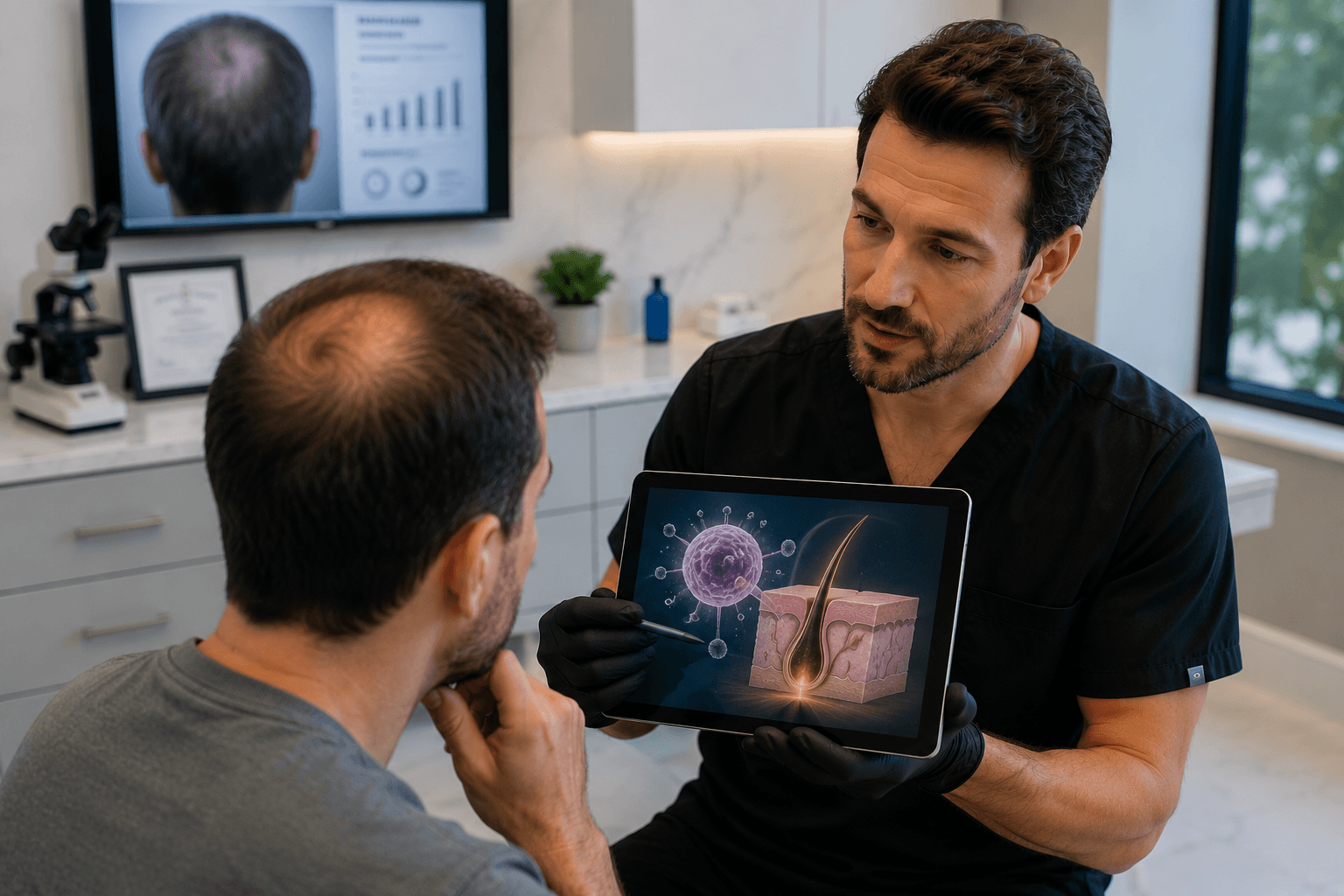
Stem cell hair treatment refers to a category of regenerative approaches that aim to use the body's own repair mechanisms, specifically stem cells or stem cell-derived growth factors, to reactivate dormant hair follicles and encourage new growth. The theory is compelling: stem cells have the ability to signal tissue repair and regeneration, and hair follicles rely on a small population of stem cells at their base to keep producing hair over a person's lifetime.
Is Stem Cell Hair Treatment FDA Approved?
As of now, most stem cell-based hair treatments are still considered investigational in the United States. They're being studied in clinical trials and academic research settings, but they haven't received the same level of regulatory approval and widespread clinical validation as other regenerative options. This is an important distinction, because it means the treatments being marketed under this name can vary enormously in quality, safety, and evidence behind them.
What Does the Research Actually Say?
Early studies on stem cell-based approaches to hair loss have shown promise, particularly around improving hair density and follicle activity in people with androgenetic alopecia. However, most of this research is still in relatively early phases, with smaller sample sizes and shorter follow-up periods than the gold-standard treatments used in clinical practice today. Reputable sources like the American Academy of Dermatology and peer-reviewed dermatology journals continue to track this research closely, and it's worth reading up on if you're curious about where hair restoration science is heading.
What's the Difference Between Stem Cell Treatment and PRP Therapy?
This is one of the most common points of confusion, and it's an important one. Platelet-rich plasma (PRP) therapy is a regenerative treatment that is well established, widely used, and backed by a growing body of clinical evidence. PRP works by concentrating growth factors from your own blood and injecting them into the scalp to stimulate follicle activity, improve blood supply to the hair root, and extend the growth phase of the hair cycle.
While PRP and stem cell therapy both fall under the broader umbrella of regenerative medicine, and both rely on the idea of using the body's own biology to encourage healing, they are not the same treatment. PRP has a longer clinical track record specifically for hair restoration and is the regenerative option we offer at California Hair and Skin Institute. We also offer PRF, or platelet-rich fibrin, which uses a similar principle with a slightly different concentration and release profile of growth factors.
Who Tends to Ask About Regenerative Hair Treatments?
People usually start researching regenerative options like this after noticing early thinning, a widening part, or a receding hairline, and after wanting to explore non-surgical solutions before considering a transplant. If that sounds like you, the good news is that PRP and PRF therapy address many of the same goals people hope to achieve with newer, less established treatments, using an approach with a stronger evidence base available today.
What Can PRP and PRF Actually Do for Thinning Hair?
For the right candidate, PRP and PRF can help slow further shedding, improve the thickness and quality of existing hair, and support a healthier scalp environment for regrowth. It works best on follicles that are miniaturized but still active, which is why earlier intervention tends to produce better results. You can find more detail on our PRP and PRF page and our PRP gel treatment page.
How Does Regenerative Therapy Fit Into a Hair Restoration Plan?
For many patients, PRP isn't a standalone fix but one part of a broader hair restoration strategy. It can be used on its own for early to moderate thinning, or alongside a surgical option like an FUE hair transplant to support graft health and maintain density in the surrounding native hair. You can learn more about our surgical option on the FUE hair transplant page.
Should I Wait for Stem Cell Treatment to Become More Available?
This is a fair question, and the honest answer is that hair loss tends to progress over time, particularly with genetic pattern hair loss. Waiting for a treatment that's still in research phases means those follicles continue to miniaturize, which can reduce the odds of a good response even if that treatment eventually becomes widely available. Starting with a proven regenerative option now, and staying informed about the research as it develops, is generally the more strategic approach.
What Should I Look for When Researching Regenerative Hair Treatments?
Whenever you're evaluating any regenerative treatment for hair loss, it's worth asking a few questions: Is this treatment backed by peer-reviewed clinical research specific to hair restoration? Is the provider using your own biological material (like PRP) or a third-party product with less regulatory oversight? What does recovery and the expected timeline actually look like? A good provider should be transparent about all of this during your consultation rather than relying on buzzwords.
Getting a Personalized Recommendation in San Diego
The best way to know what's right for your specific type and stage of hair loss is a consultation where your scalp can be properly evaluated. During your visit at California Hair and Skin Institute, we'll walk through your history, examine your follicle density, and recommend whether PRP, PRF, a transplant, or a combination approach makes the most sense. You can schedule yours through our hair restoration consultations page.
Frequently Asked Questions
Is stem cell hair treatment the same as PRP? No. They're both regenerative approaches, but PRP uses concentrated growth factors from your own blood and has a longer clinical track record for hair restoration, while stem cell-based treatments are still largely in research and clinical trial phases.
Does PRP use stem cells? Not directly. PRP concentrates platelets and growth factors from your blood plasma rather than isolating stem cells, though both approaches aim to stimulate the body's natural repair processes at the follicle level.
How many PRP sessions are typically needed? Most patients start with a series of sessions spaced several weeks apart, followed by periodic maintenance treatments. Your specific plan will depend on the extent of your thinning.
Can regenerative treatments regrow hair that's completely gone? Regenerative treatments like PRP work best on follicles that are still active but miniaturized. Areas with long-term, complete follicle loss typically require a surgical option like an FUE transplant instead.
Is PRP safe? PRP uses your own blood, which minimizes the risk of allergic reaction or rejection. As with any procedure, it should be performed by a trained provider following proper protocols.
The Verdict: Science Fiction vs. Same-Day Solution
Stem cell hair treatment is a genuinely exciting area of research, and it's worth keeping an eye on as studies continue to develop. But if you're dealing with thinning hair today, you don't have to wait on the sidelines for the science to catch up. PRP and PRF offer a proven, accessible way to support regrowth right now. If you're in San Diego and curious what regenerative treatment could do for your hair, we're happy to walk you through it.