

How Much Does a Hair Transplant Cost in San Diego, and What Are You Actually Paying For?
Updated October 2026
Most people start their hair restoration research with one question: what is this going to cost me? It's a fair question, and a frustrating one, because the honest answer is "it depends." Hair transplant cost in San Diego can vary by thousands of dollars from one patient to the next, and two quotes that look similar on paper can represent very different levels of care.
This guide breaks down what actually drives the price of a hair transplant, why the cheapest quote rarely ends up being the least expensive choice, and how to think about value whether you're a busy professional budgeting around your calendar or someone who simply wants the best result available. At California Hair and Skin Institute, every plan starts with a consultation, so you know exactly what your investment covers before you commit to anything.
How Much Does a Hair Transplant Usually Cost in San Diego?
In the United States, a hair transplant commonly ranges from roughly $4,000 to $15,000 or more, depending mostly on how many grafts you need. Southern California prices tend to sit in the middle to upper part of that range. Your personal number comes from your hair loss pattern, your donor supply, and the technique used.
Rather than fixating on a single figure, it helps to understand the moving parts. Once you see how a quote is built, you can compare clinics on equal footing.
Why Do Clinics Price by the Graft?
Many practices price by the graft because the number of grafts reflects the amount of work involved. A graft is a follicular unit, a natural grouping of one to four hairs. Restoring a slightly receding temple area might take a modest number of grafts, while rebuilding a frontal hairline and filling a thinning crown can take several thousand.
Some clinics quote a flat session fee instead. Neither model is automatically better. What matters is that you know how many grafts are planned and whether your quote covers everything from the procedure to your follow-up visits.
What Factors Raise or Lower the Price?
Several variables shape your final quote:
- Extent of hair loss. Larger areas need more grafts and more time.
- Donor hair quality. Dense, healthy donor hair makes extraction more efficient.
- Technique. Automated FUE systems like NeoGraft involve specialized equipment and a skilled team.
- Who performs the procedure. A physician who personally handles your hairline design and placement brings a different level of expertise than a technician-led model.
- Aftercare. Follow-up appointments, professional washing, and progress tracking add real value.
What Is Included in the Cost of an FUE Hair Transplant?
A complete FUE quote should cover your consultation, the procedure itself, local anesthesia, and structured post-operative care. If any of those pieces are missing, your "low" price may grow later.
At California Hair and Skin Institute, the FUE hair transplant using NeoGraft is performed by Dr. Vakas Sial, who brings 25 years of clinical experience and personally designs each hairline. Individual follicles are harvested from the back of the scalp and placed at precise angles to match natural growth, with no scalpel, no stitches, and no linear scar.
Your plan also includes post-transplant care and follow-up, with an early check and professional wash in the first 24 to 48 hours, plus long-term monitoring at the six and twelve month marks. Those visits protect your grafts, which is ultimately what protects your investment.
Are There Hidden Costs to Watch For?
Ask whether a quote includes medications, aftercare products, and follow-up appointments. Also ask what happens if you need a second session down the road. Hair loss can continue around transplanted areas, so a clinic that talks openly about long-term planning is giving you a more realistic picture of total cost.
Is a Cheaper Hair Transplant Worth the Savings?
Usually not. The lowest price often reflects shortcuts in who performs the work, how many grafts survive, or how naturally the hairline is designed, and correcting a poor result costs far more than doing it right once.
This is especially true for hairline work. A hairline that's too low, too straight, or too dense for your age can look unnatural for decades. Graft survival matters too. If a meaningful share of grafts doesn't take, you've paid for hair you'll never see.
What About Hair Transplant Tourism?
Medical travel packages are heavily advertised and sometimes look like a bargain. Before you book, consider the hidden costs: flights, hotel nights, time away from work, and the difficulty of getting follow-up care once you're home. The International Society of Hair Restoration Surgery has publicly raised concerns about unlicensed operators in some markets performing surgery without proper physician oversight. Having your surgeon fifteen minutes away in Mission Valley, rather than an ocean away, has real value when you have a question during week one.
How Should Busy Professionals Budget for a Hair Transplant?
For working professionals, the true cost includes time away from work as well as the procedure fee. With FUE, most patients return to work and normal routines within a few days, which keeps that hidden cost low.
If you work downtown, in Sorrento Valley, or anywhere along the I-8 corridor, you can plan around a long weekend. A few practical tips:
- Schedule your procedure on a Thursday or Friday so the most visible healing happens over the weekend.
- Expect some redness and small crusts during the first week or so.
- Skip heavy exercise for at least one week to protect the new grafts.
- Block time for your follow-up visits now, so they don't compete with deadlines later.
Stress plays a role here as well. If you've noticed shedding during a demanding season at work, it's worth reading about whether stress-related hair loss can be treated with a hair transplant before deciding on surgery. Some stress shedding resolves on its own, and a good consultation will tell you which kind you're dealing with.
Why Do Luxury and High-End Clients Focus on Value Over Price?
Clients who are used to premium services tend to ask a different question: not "what's the cheapest option" but "what gives me the most natural, permanent result with the least disruption." That framing usually leads to the right decision.
For this group, the details that matter most are physician involvement, privacy, artistry, and continuity of care. At California Hair and Skin Institute, Dr. Sial performs procedures personally rather than delegating them to technicians. The practice also follows documented FUE surgical protocols and a formal quality assurance and outcome tracking program, which is the kind of accountability discerning patients look for. As the clinic puts it, "You will not look like you had a procedure. You will just look like you."
Can Non-Surgical Options Reduce Your Overall Cost?
Sometimes. If your hair is thinning rather than fully gone, regenerative treatments may strengthen existing follicles and delay or reduce the number of grafts you eventually need. Pairing approaches can also help protect your transplant results over time.
PRP and PRF therapy uses concentrated platelets from your own blood to support the scalp, and the clinic typically recommends an initial series of three treatments spaced several weeks apart. You can learn more in this article on whether PRP can help hair thinning and hair loss.
Is a Hair Transplant Covered by Insurance?
In most cases, no. Hair transplants for pattern hair loss are considered cosmetic, so insurance generally doesn't cover them. Many patients use savings or third-party medical financing, so it's worth asking about payment options and any current promotions during your consultation.
How Do You Get an Accurate Quote?
The only reliable quote comes from an in-person evaluation of your scalp and donor area. Online calculators can't measure donor density, see miniaturization, or account for your family history.
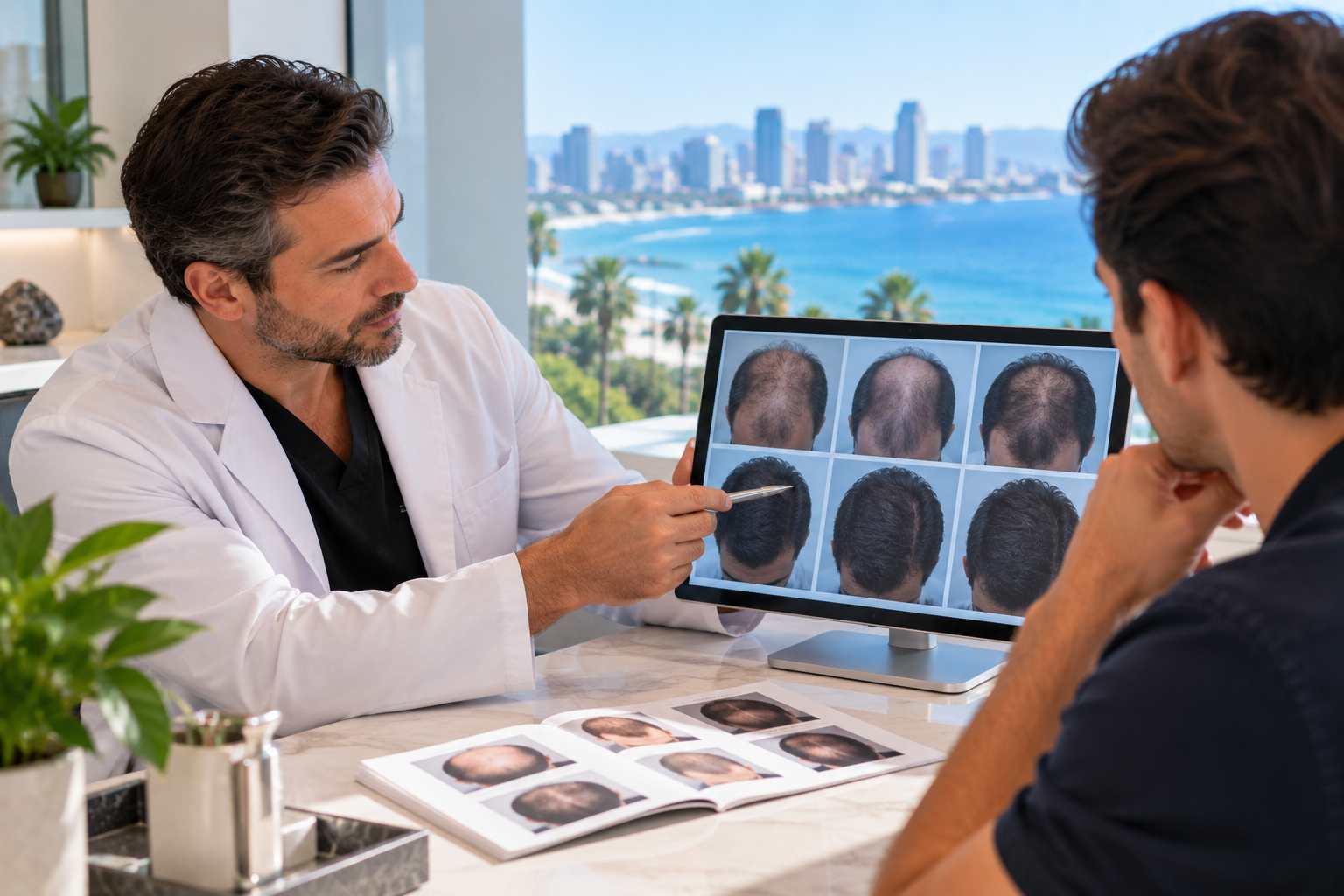
A hair restoration consultation with Dr. Sial takes about 30 to 45 minutes. He reviews your hair loss history, examines your donor area, identifies the type of hair loss you have, and builds a plan around your goals. You leave knowing your estimated graft count, your options, and your total investment. Men dealing with a balding or receding hairline and women noticing thinning hair both get a plan built around their specific pattern.
Frequently Asked Questions
How much does a hair transplant cost in San Diego?
Most hair transplants in the U.S. range from about $4,000 to $15,000 or more, and San Diego pricing generally falls within that range. Your exact cost depends on how many grafts you need, your donor hair quality, and the technique used.
Why does hair transplant cost vary so much between clinics?
Prices reflect who performs the work, the technology used, graft survival standards, and how much aftercare is included. A physician-performed FUE with structured follow-up will cost more than a technician-led procedure with minimal support.
Is FUE more expensive than other hair transplant methods?
FUE can cost more than older strip methods because each follicle is extracted individually. Many patients feel the trade-off is worth it, since FUE avoids a linear scar and allows a faster return to normal routines.
Are hair transplant results permanent?
Transplanted follicles come from areas resistant to balding, so they typically continue growing for life. Surrounding native hair can still thin over time, which is why long-term planning matters.
When will I see results from my investment?
New growth usually appears around three to four months after the procedure, with optimal density visible between nine and twelve months.
Your Hair, Your Budget, Your Best Move
A hair transplant is one of the few cosmetic investments that can last a lifetime, which makes it worth doing carefully. The right price is the one that buys you a natural hairline, healthy graft survival, and a team that's still there for you months later. If you're ready to see your real numbers, contact California Hair and Skin Institute to schedule your consultation in San Diego and get a personalized plan built around your hair, your goals, and your timeline.