
What Should You Look for in a Hair Implant Clinic in San Diego?
Updated October 2026
Choosing a hair implant clinic is a little like choosing an architect. You're not just buying a procedure. You're trusting someone to design something you'll live with every day for the rest of your life. A hairline that looks natural at 35 should still look natural at 60, and that takes more than good equipment.
San Diego has no shortage of clinics advertising hair restoration, which makes the decision harder rather than easier. This guide walks you through the questions that separate a truly qualified practice from a polished website, with a special look at what discerning, high-expectation clients and women considering restoration should weigh before booking.
What Exactly Is a Hair Implant Clinic?
A hair implant clinic is a practice that restores hair by moving your own healthy follicles from a donor area, usually the back of the scalp, to thinning or balding areas. "Hair implants" is the everyday term for what physicians call a hair transplant.
The best clinics do more than perform surgery. They diagnose why you're losing hair, decide whether a transplant is even the right answer, and support you through a full year of growth. At California Hair and Skin Institute, that approach covers scalp, beard, and brow restoration under one physician-led roof.
Who Actually Performs the Procedure?
This is the single most important question you can ask. In some high-volume clinics, a physician briefly appears while technicians do most of the extraction and placement. In others, the physician designs the hairline and handles the critical steps personally.
At California Hair and Skin Institute, Dr. Vakas Sial personally performs procedures rather than delegating them to technicians. He brings 25 years of clinical experience and a focus on hairline design that reads as natural, not "done." You can learn more about his background on the about page.
Why Does Physician Involvement Matter So Much?
Natural results depend on hundreds of tiny decisions: the angle of each graft, its depth, the spacing between follicles, and how the hairline softens at the edges. These details are what prevent the "tell-tale signs of traditional hair plugs." When the person making those decisions is a physician with decades of experience, you're far more likely to get a result nobody notices.
How Does a Quality Clinic Decide If You're a Candidate?
A trustworthy clinic will sometimes tell you "not yet" or "not this." Honest screening protects you from a procedure that won't serve you long term.
Look for a practice with written hair transplant patient selection criteria. Good candidacy decisions consider your age, the stability of your hair loss pattern, your donor density, and whether something like stress, a medical condition, or a recent illness is driving temporary shedding. For a deeper look, read who is a good candidate for hair replacement in San Diego.
What Should Happen During Your First Consultation?
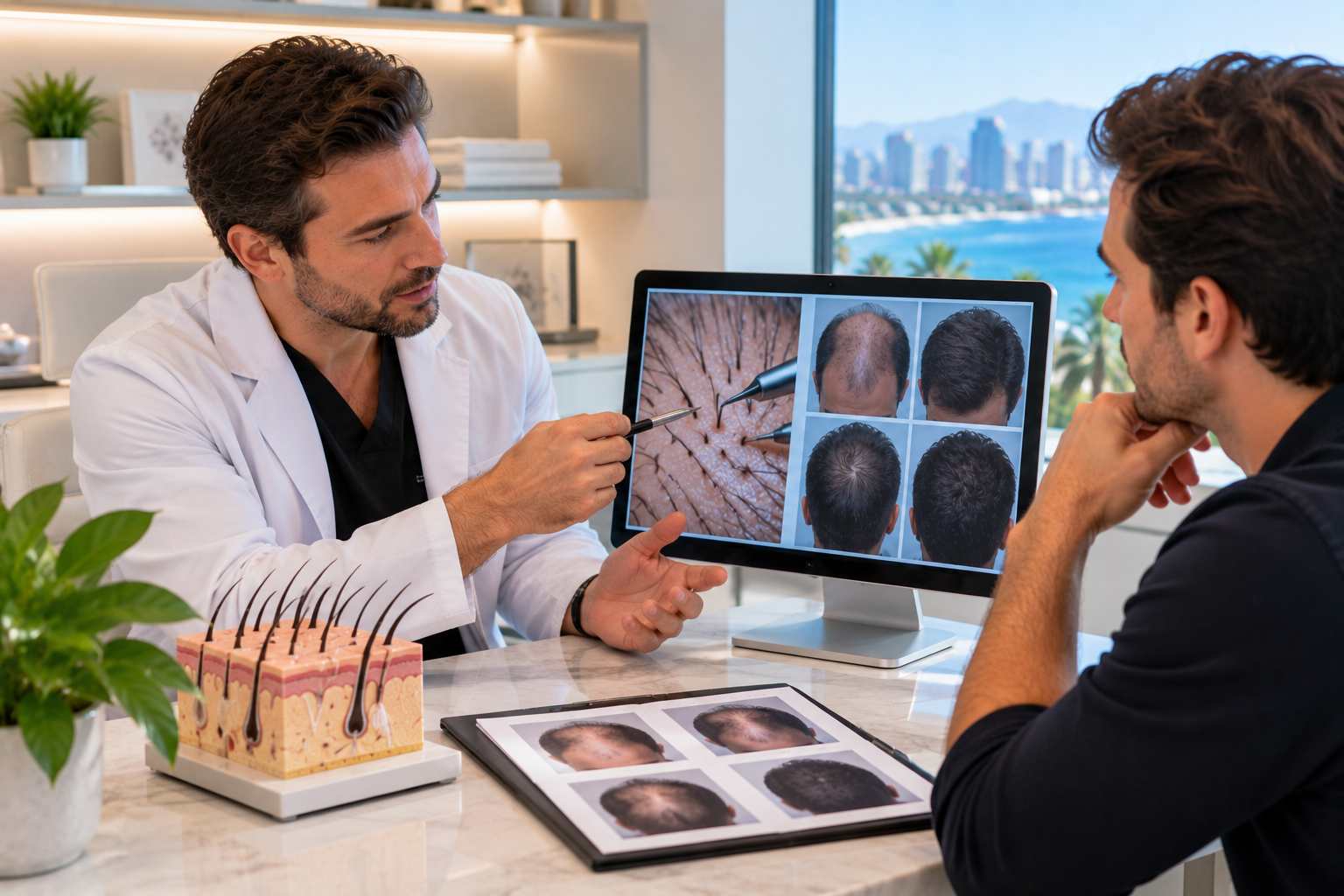
Expect a real medical evaluation, not a sales pitch. A hair restoration consultation at California Hair and Skin Institute runs about 30 to 45 minutes and includes:
- A review of your hair loss history and any past treatments
- A detailed scalp exam and donor density evaluation
- A follicle health assessment using specialized tools
- Identification of your specific type of alopecia
- A personalized roadmap that may include surgical or non-surgical options
What Safety Standards Should a Hair Implant Clinic Have?
A reputable clinic should be able to show you its safety and sterilization policies without hesitation. Hair transplantation is a surgical procedure, even when it's minimally invasive, and it deserves surgical-level standards.
California Hair and Skin Institute publishes its infection prevention and sterilization policy, its emergency response and anaphylaxis protocol, and its post-operative care protocol. That level of transparency is rare, and it's a good sign. You can also take a look at the facility in Mission Valley before your visit.
Which Red Flags Should Make You Walk Away?
- Pressure to book the same day with a "today only" discount
- Vague answers about who performs the surgery
- Guaranteed graft counts quoted without an exam
- No plan for follow-up care after the procedure
- Before-and-after photos with inconsistent lighting, angles, or haircuts
What Technique Should a Modern Clinic Use?
Most patients today prefer follicular unit extraction, or FUE, because it avoids a linear scar and heals quickly. Ask any clinic which method they use and why it suits your case.
California Hair and Skin Institute offers FUE hair transplant using NeoGraft, an automated system that uses gentle pneumatic pressure to harvest individual follicles. There are no scalpels or stitches, and most patients return to normal routines within a few days. That matters if you'd rather keep your procedure private.
What Do High-End Clients Expect From a Hair Implant Clinic?
Clients accustomed to premium care tend to judge a clinic on artistry, discretion, and continuity rather than price alone. They want a physician they can reach, a plan that thinks ten years ahead, and documentation that proves results.
How Do You Verify a Clinic's Results?
Ask to see real outcomes from patients with hair similar to yours. The clinic's before and after gallery and patient reviews are good starting points. A clinic that follows a formal photography and video documentation policy is taking consistent photos under consistent conditions, so its comparisons are more trustworthy. Outcome tracking through a quality assurance program adds another layer of accountability.
What Should Women Look for in a Hair Implant Clinic?
Women should look for a clinic that understands female hair loss is different. Women often experience diffuse thinning across the top of the scalp rather than a receding hairline, and not every woman is a transplant candidate.
The American Academy of Dermatology notes that hereditary hair loss affects millions of women in the United States, often appearing as a widening part. A good clinic will check whether hormones, thyroid issues, iron levels, postpartum changes, or stress might be contributing before recommending surgery. For many women, PRP and PRF therapy is a smart first step to strengthen existing follicles, while women with stable, localized thinning or a high forehead may benefit from FUE.
Can a Clinic Restore More Than Scalp Hair?
Yes. Many women seek help for sparse brows after years of over-plucking, and a female eyebrow transplant offers a permanent option using real hair. Men often ask about patchy facial hair, which is where beard restoration comes in. A clinic with experience across these areas generally has a finer eye for detail overall.
What Should Aftercare Look Like?
A great clinic stays involved long after procedure day. Your grafts are most vulnerable in the first week, and your results take nine to twelve months to fully mature.
Look for post-transplant care and follow-up that includes an early post-op check with a professional wash, clear instructions, a direct line for questions, and scheduled visits at six and twelve months. In sunny San Diego, guidance on protecting your scalp from UV exposure during healing is especially important.
Frequently Asked Questions
How do I choose the best hair implant clinic in San Diego?
Look for a clinic where the physician personally performs the procedure, offers honest candidacy screening, publishes its safety protocols, and provides structured aftercare. Reviewing real before-and-after photos of patients with similar hair is also essential.
Are hair implants and hair transplants the same thing?
Yes. "Hair implants" is the common term, while "hair transplant" is the medical term. Both describe moving your own healthy follicles to areas of thinning or balding.
Can women get hair implants?
Many women can, especially those with stable, localized thinning or a high hairline. Women with diffuse thinning may benefit more from regenerative treatments first, which a consultation will clarify.
How long does a hair implant procedure take?
It depends on how many grafts you need. Most FUE procedures take several hours and are performed under local anesthesia, so you're comfortable and awake.
When will I see results?
New growth usually begins around three to four months, with optimal density visible between nine and twelve months.
Choose Your Clinic Like You'll See the Results Forever (Because You Will)
The right hair implant clinic combines medical judgment, artistic skill, and genuine follow-through. If you want a physician-led practice that puts your long-term result ahead of a quick sale, schedule a consultation with California Hair and Skin Institute in San Diego and get a plan designed around your hair, your face, and your goals.